
Behind the Build
Behind the Build
At Fox Cities Habitat, our mission is to bring people together to build homes, communities and hope. Through our Homebuyer program, families work toward the strength and stability of homeownership. Habitat homebuyers purchase their home with an affordable, 0% interest mortgage.
One of the most visible parts of our mission is new home construction. Throughout the year, volunteers, community partners, contractors and future homebuyers work together to turn an empty lot into a place a family can call home. As part of the Homebuyer program, future homebuyers contribute sweat equity hours by working on their own home, other Habitat homes and in other areas of our mission. Click here to learn more about sweat equity and what it means for Habitat homebuyers.
Newly built Fox Cities Habitat homes are modest, decent and typically have one story, with a minimum of two bedrooms. Home size and square footage depend on family size, accessibility needs or lot size.
But who and what goes into building a new Habitat home? Follow along as we take you from the first scoop of dirt to the finishing touches.
1.) Excavation and Foundation
Completed by: Contractors
Every new home must start with a strong foundation.
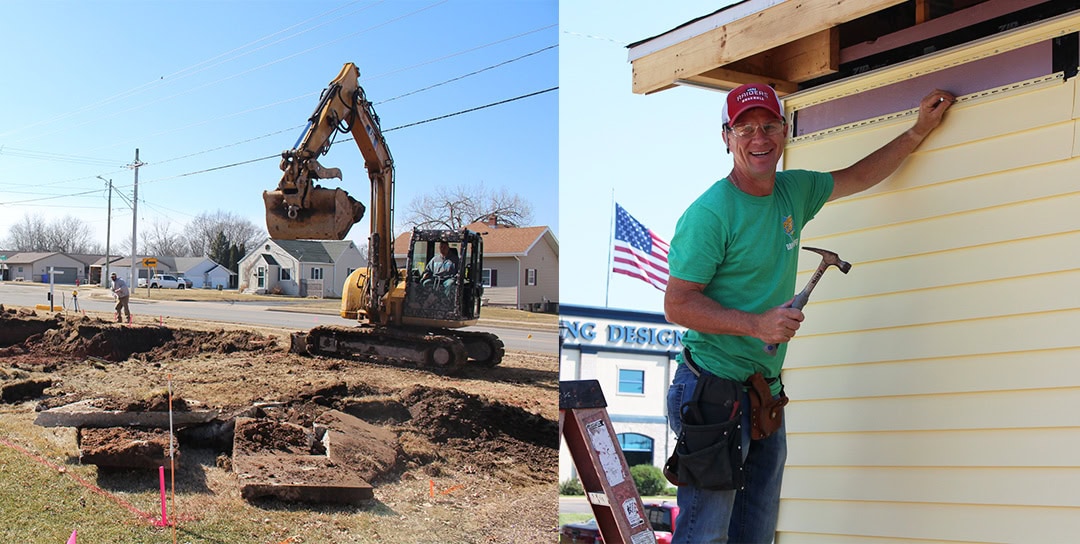
Before volunteers arrive on site, subcontractors prepare the property through excavation, digging the area where the home will sit. From there, the foundation and basement walls are poured, and exterior foundation insulation is installed.


It may not look much like a home yet, but these first steps create the strong base for everything that follows.
2.) Beam and Sill
Completed by: Volunteers and Staff
With a strong foundation in place, volunteers can begin building. During the beam and sill phase, treated sill plates are secured along the top of the foundation, and supporting beams and I-joists are installed. Together, these pieces help support the floor system that will soon span the foundation.
This is one of the first opportunities for general and sponsor volunteers to get involved on the build site.


3.) Capping the Foundation
Completed by: Volunteers and Staff
This is an exciting milestone because the home gets its floor! Sheets of sturdy floor decking are secured over the joists, creating a solid surface where the walls of the home can be built.
By the end of this stage, the outline of the foundation has become a working platform for the home above it.


4.) Building the Walls
Completed by: Volunteers and Staff
At this phase, it really starts to look like a house!
Before a wall can be raised, volunteers carefully lay out where exterior and interior walls, windows and doors will go. The walls are then framed on the floor of the home before volunteers work together to raise and secure them into place.
Over the course of just a few build days, an open platform begins transforming into recognizable rooms.


Raising the Walls

5.) Gables and Roof
Completed by: Contractors and Skilled Partners
Once the main walls are standing, work moves upward. The gables form the upper portions of the home’s end walls, helping create the shape of the roof. Raising them, along with the roof trusses, takes more than hands on the build site. A specialized volunteer team and skilled partners, including telehandler operators and crane crews, donate their time, equipment and expertise to help safely lift these large structural pieces into place.
From there, our specialized roofing volunteers continue the roof framing process, securing the trusses and installing roof sheathing to create the structure overhead. Once the roof structure is ready, roofing subcontractors step in to install the shingles, helping protect the home from the elements.
It’s one of the most dramatic visual changes during construction. In a relatively short period, the structure goes from a collection of walls to the familiar shape of a home, complete with a roof that will provide shelter and protection for the family who will soon call it home.


6.) Windows and Exterior Doors
Completed by: Volunteers and Staff
Next, the openings that were carefully planned during wall framing are filled with windows and exterior doors.


7.) Electrical, Plumbing and HVAC Rough-In
Completed by: Contractors and Skilled Partners
Before the walls are closed, the systems that will make the house function need to be installed.
Electrical wiring, plumbing lines and heating, ventilation, and air conditioning systems are routed throughout the home while the framing is still exposed. Much of this specialized work is completed by subcontractors and skilled partners. Fox Cities Habitat also partners with Fox Valley Technical College’s electrical program, giving students an opportunity to gain hands-on experience while contributing to Habitat homes.
Much of this work will eventually be hidden behind walls, but it is essential to creating a safe, comfortable and functional home.


8.) Siding
Completed by: Volunteers and Staff
Outside, the home continues to take shape as siding, soffit and other exterior finishes are installed.
Siding does more than give the home its finished appearance. It helps protect the structure from the elements, and this step is another major milestone as the build site begins looking much more like a finished home. Homebuyers select the siding color, adding a personal touch as the house begins to feel more and more like their future home.


9.) Air Sealing and Insulation
Completed by: Volunteers and Staff
During this stage, volunteers carefully seal gaps where air could move in or out of the house. Insulation and a vapor barriers are installed within the walls. The vapor barrier helps prevent moisture from moving into the walls, protecting the home from condensation and potential moisture damage.
Together, these steps help create a more comfortable and energy-efficient home, helping keep heating and cooling costs manageable for the future homeowner.


10.) Drywall and Plaster
Drywall completed by: Volunteers and Staff
Plastering completed by: Contractors
With insulation in place and the home’s mechanical systems roughed in, it is time to close the walls. Volunteers install sheets of drywall across the ceilings and walls, covering the framing and beginning to define each room. Professional contractors then complete the plastering needed to create smooth surfaces for painting.
Suddenly, you are no longer looking through studs from one side of the house to the other. Bedrooms, bathrooms, hallways and living spaces feel like individual rooms.


11.) Painting
Completed by: Volunteers (including the future homebuyer family!)
After the walls are prepared, volunteers prime and paint the interior of the home. Painting is also one of the build days future homebuyers are required to participate in, giving them another opportunity to work alongside volunteers and play a hands-on role in bringing their future home to life.


12.) Flooring
Completed by: Contractors
Finished flooring brings another major transformation. Contractors install vinyl flooring in areas such as the kitchen and bathrooms, while carpet is typically installed in the other areas of the home. Flooring needs may also be adjusted when necessary to accommodate a homeowner’s medical needs.
With finished floors underfoot, the home is getting closer to move-in ready.


13.) Cabinets, Doors, Trim and Finish Work
Completed by: Volunteers and Staff
As construction moves closer to the finish line, attention turns to the features and details that make each room functional and complete. Volunteers install kitchen cabinets, countertops, bathroom vanities and interior doors, along with trim and finish work throughout the home. Depending on the home, this can also include closet shelving, blinds, appliances, vent covers, exterior finishing pieces and other final touches.
At this stage, the kitchen starts looking like a kitchen, bedrooms and closets have doors, and the home is nearly complete!


14. Mechanical Finishing
Completed by: Skilled partners and Contractors
Remember the electrical, plumbing and HVAC systems installed earlier in the build? Now those systems receive their finishing touches. Contractors return to complete work such as installing sinks, toilets, electrical fixtures and HVAC components. These are the details that turn the structure into a fully functioning home.

15.) Clean Day
Completed by: The future homebuyers, their family and friends, and other volunteers
After months of construction, there is one last job before dedication: getting the home sparkling clean.
The future homeowner is joined by family and friends to clean the house from top to bottom. Other Habitat families completing sweat equity and sponsor volunteers may also lend a hand.
It is one of the final steps in a process that has brought together hundreds of individual tasks and many different hands around one shared goal.
More Than a House
By dedication day, it can be easy to look at a finished home and forget everything that came before it. Click here to learn more about what happens at a Habitat home dedication and why these celebrations are so meaningful.
Behind every room are volunteers who gave their time, skilled partners who shared their expertise, contractors who completed specialized work and a future homeowner who worked alongside them throughout the journey.
That is what makes a Habitat build different. A home is not simply constructed for a family. It is built with them and alongside a community of people who believe everyone deserves a safe, affordable place to call home.


